
Now We Are Three
The Spatchcocking Continues

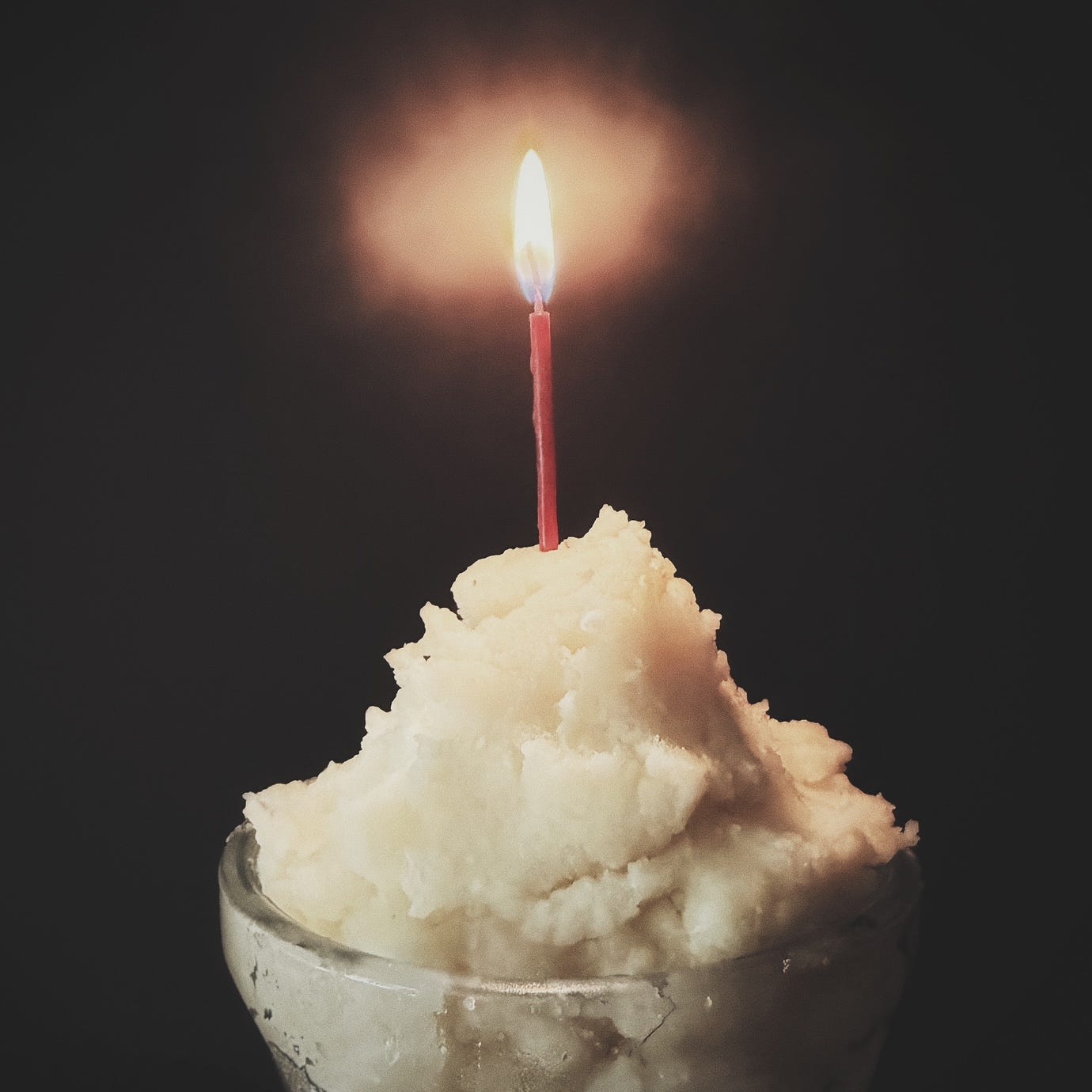
Three years ago today, I assassinated my blog—stabbed in the back on the Ides of March with a knife I liberated from evil French television chef, Jacques Pépin.
As Food for the Thoughtless lay dying on my freshly scrubbed kitchen tiles with that six inch Sabatier planted deep between its phantom shoulder blades, a newer, fresher newsletter was being metaphorically birthed on the recently shampooed rug in the next room.
In short: Happy Third Birthday, Spatchcock.
I thought long and hard about how to celebrate. Do I bake it a cake? No. I live alone and have little impulse control. Might I throw it a party? In this economy? Should I have written it a sonnet? I lost my rhyming dictionary at the water park. Would a non-sentient newsletter appreciate a Strip-o-Gram? Perhaps, if puppet shows, tacos, and space games are involved.
In a year filled with endless months of existential dread, I wondered if I dare mark the occasion at all.
Of course I should—everybody needs something to celebrate. I’ll just do it real quiet like. No Roman candles, no angels’ choir, no sound of distant drumming.
For last year’s anniversary, I spatchcocked some quail, because it seemed right for the occasion, and my friend Craig complained that I had yet to spatchcock anything, which felt like a crime.
I like the idea of making the surgical removal of bird backs an annual Spatchcock tradition. I should plan to increase the size of the animal incrementally, year-by-year. Not only will this give much needed structure to my writing calendar, but it will afford me plenty of time to save up for and source a cassowary for this newsletter’s tenth or eleventh anniversary.
This year, I have opted for Cornish game hens. I should have gone smaller, but I don’t have easy access to mourning doves or rock ptarmigans, like other Substackers I know.
Cornish game hens feel celebratory and vaguely nostalgic, in a 1970s sort of way. But trips down memory lane are sometimes paved with wistful misremembrance. Cornish game hens are neither Cornish nor game, and you’ve got a 50/50 chance that yours is even a hen.
This once exotic-feeling poultry was the result of inter-galliform breeding experiments conducted by a couple of chicken farmers from Connecticut in the 1950s. Cornish game cocks (originally bred—unsuccessfully—for cockfighting) were encouraged to take an interest in White Plymouth Rock hens and—through the magic of cloacal kisses—the petite, fast growing, big breasted specialty roasting bird was born.
Rice pilaf not included.
Before yesterday morning, I’d never cooked a Cornish game hen in my life. I bought one once, but it worked its way to the back of my freezer, where it remained for several years. Determined not to commit the same crime twice, I removed the two I’d purchased roughly twenty-four hours earlier from their individual plastic wrapping, sprinkled them liberally with salt, and set them in a large dish on the counter until I decided their culinary fate.
Not wanting to face the grocery store on a weekend morning, I foraged through the fridge, pantry shelves, and cupboards to come up with something worthy of my little birds.
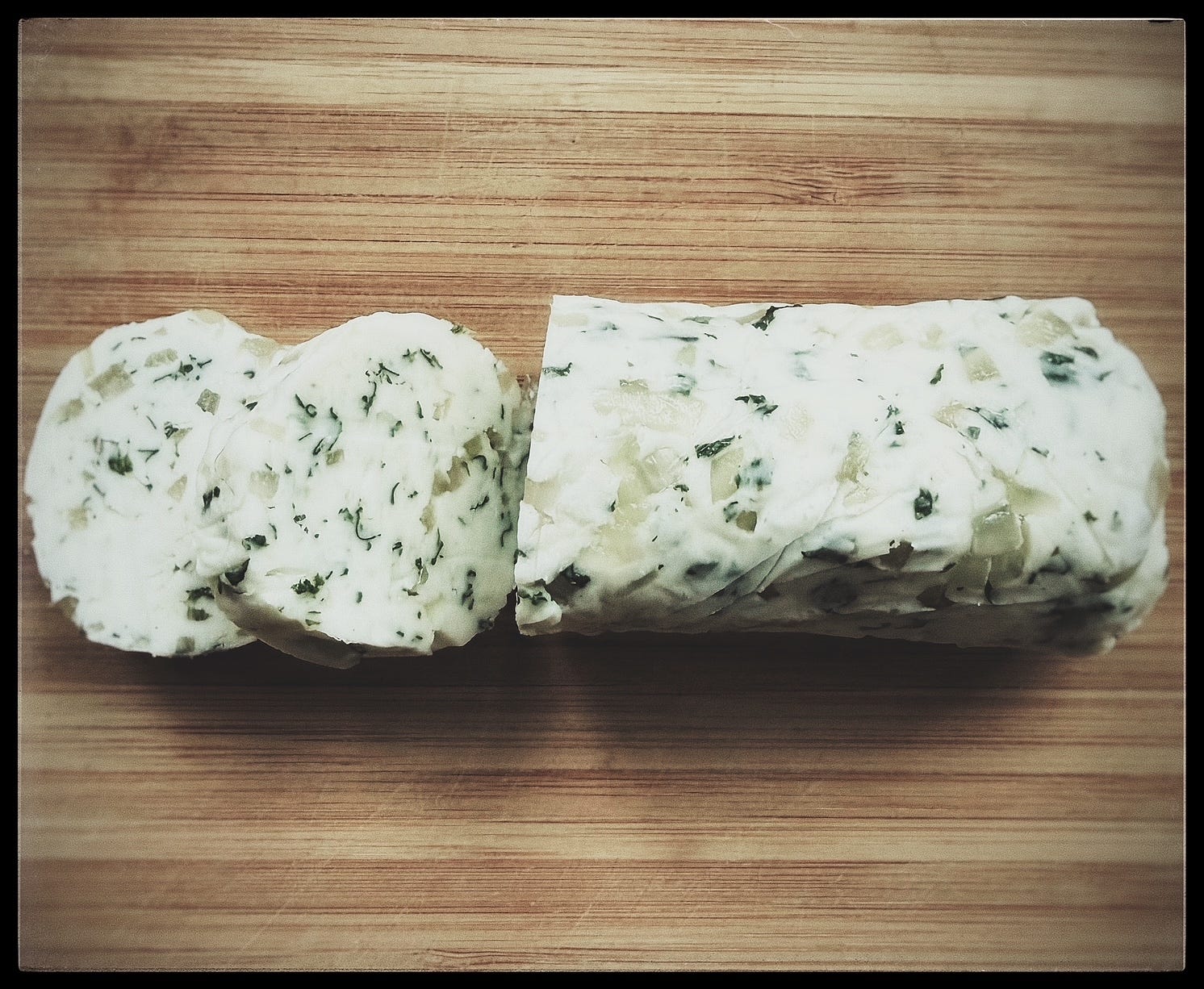
I found a bit of tarragon I’d bought last week that was losing its will to live, and a shallot just minding its own business in a bowl of bigger, stronger alliums. I hacked them into little pieces, mashed them into some room temperature butter with a bit of kosher salt, and rolled it all up into a log of compound butter, which would be lovely slipped under the birds’ skin.
I got out my kitchen scissors to properly spatchcock the carcasses, but got distracted by a particularly chaotic Tribal Council on Australian Survivor and accidentally cut through the breast bone of the first bird. I was able to give the second bird my full attention during the next ad break.
I turned on the oven to a rather high heat (400℉), rough chopped an onion and some carrots that had spent too long above ground, and tossed them into my large ceramic roasting pan.
Loosening the skin on the game hens, I sliced off discs of tarragon butter and slipped them in next to the flesh.
I had half a jar of apricot jam on hand, which I gently melted in a small saucepan on the stove, stirring in a tablespoon or so of Dijon mustard as it warmed and liquified.
The little bit of tarragon I had left, I divided and placed on the underside of the birds, which I next arranged over the chopped carrots and onions, then painted a generous amount of the apricot-mustard glaze over them.
About third of a bottle of white wine was found in the door of the fridge behind the buttermilk, so I poured that over the vegetables, and shoved everything into the oven for 30 minutes—the time in which I managed to make some mashed potatoes (using up the rest of that buttermilk), do the washing up, and listen to an episode of The Unbelievable Truth in which Richard Osman talks about nuts.
After 30 minutes, I checked in on the poor, backless and frontless creatures, turning the oven down to 350℉, because the skin was beginning to blister in places and I didn’t want them to peak too soon.
I removed the birds from the oven, transferred them to a small platter, and tented them loosely with foil.
I strained the liquid from the now-spent vegetables through a strainer, deglazed the roasting pan with some chicken stock, scraped up the crusty bits and strained that, too.
I managed to reduce the liquid by at least half in a small saucepan—still listening to the radio program—and make that into a sort of pan sauce, whisking in a couple pats of butter for body and texture.
It was only 11am, but lunch, it would seem, was ready.
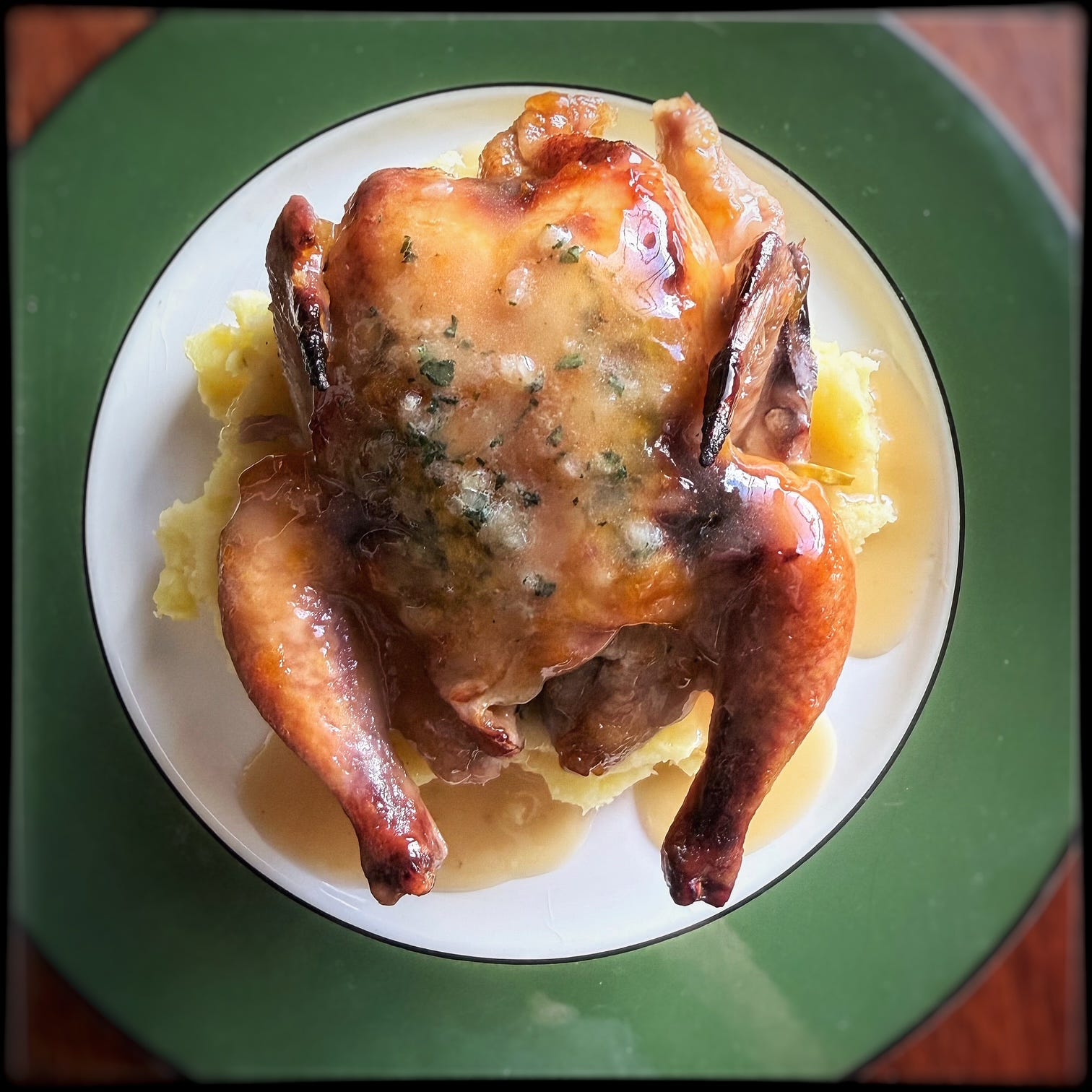
A generous base of mashed potatoes, another slice or two of compound butter on top of the bird, a generous pour of faintly sweet, tangy pan sauce over the whole thing, and I had myself a bespoke meal.
It may not look like much, but it was very, very good.
I was reminded of my post from last year, when I completely riffed the quail dish, approaching it in my own way, in my own time. “Like jazz,” is what I think I called it. “Improv” is probably the better word. No recipe, no testing, no anxiety about how it might look. Not much, at any rate. Just a quiet morning alone in my kitchen, cooking for myself and no one else.
Apparently, that’s how I prefer to commemorate my newsletter with each passing anniversary.
The last twelve months have been a time of diminishing returns here at Spatchcock. It’s been a rough, discouraging year. Not a lot of joy to revel in behind the scenes in this here Mudville.
But this morning, as I was playing in the kitchen and getting a few things wrong, I didn’t care. I wasn’t cooking for an audience—I was cooking for myself. That’s also how I write—for myself. And as long as I can find the smallest crumb of joy in the doing of it, I’ll keep on going.
Which is something to celebrate indeed.
Thanks to everyone here who decided to tag along for the ride. A surprising amount of you are excellent company. And I’ll need several of you to help me catch and kill that cassowary, so please stick around.
Now, if you feel like it, I’d love to know how you found Spatchcock in the first place. And why you stayed. Your comments are what feed me. Metaphorically, of course.
I found you on a link from Smitten Kitchen or I suppose I found Food for the Thoughtless there. I immediately felt you were kin. It may have been in the early marmalade perp days Despair, wit and good writing being a large draw for me, I awaited each missive with bated breath. Then Spatchcock arose like a roasted Phoenix (hey there’s an idea - but how does one spatchcock a mythical bird) and I continue to be curious about what you’re going to get up to next.
In honor of your anniversary:
When I lived in London decades ago, Harrods regularly stocked semi-boneless quail. They were fabulously simple to cook well and eat with abandon, without 90% of the fiddly little bones certain past husbands used to complain about. The bones that remained—wing tips and drumsticks—made it possible to truss their spineless and overly relaxed bodies into something resembling an intact quail, especially when stuffed with a delectable forcemeat.
But I and several of my food-obsessed friends became obsessed with HOW they got to be semi-boneless. I’d learned in cooking school how to completely bone out a bird: poussin, or chicken in those days. (Ballotines were, then, briefly fashionable.)
But I’d never been able to execute in less than 15 minutes. On a bet likely made after consumption of some part of a century of Port—could there possibly be some sort of bone-sucking MACHINE?—I was nominated to investigate.
The lady at Harrods butcher department supplied this answer: “Oh there’s a lovely woman in Cornwall who does them in a minute flat, darling.”