
Vichyssoise
Tainted Two Ways

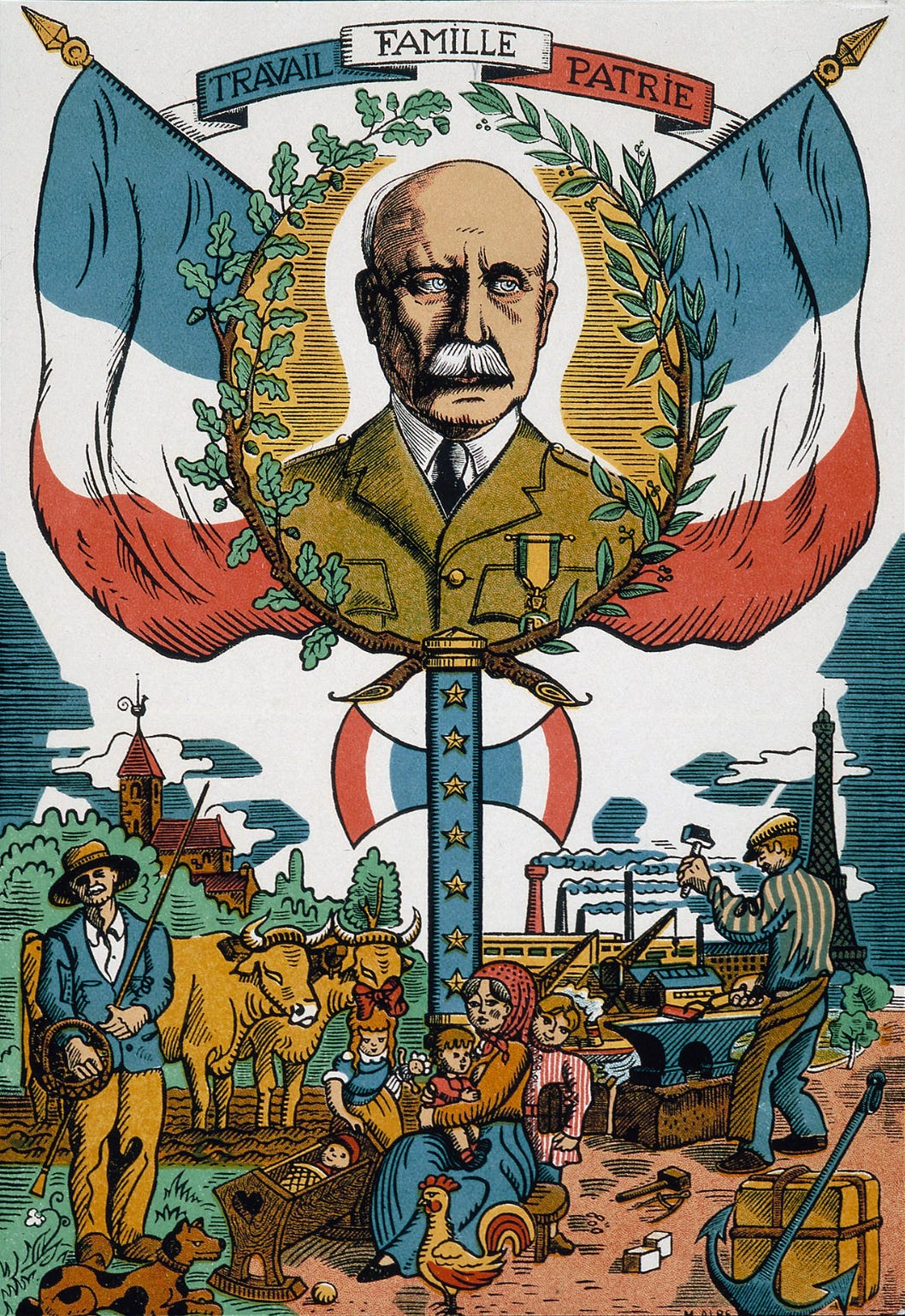
I’ve been shouldering so much rage lately, I fear I’m developing a hump, which is neither attractive nor productive.
I considered installing a punching bag in my bedroom to help free myself from some of this animus. I thought I might tape to it cutouts of faces I feel possess an overabundance of Backpfeifengesicht.
Sadly, boxing equipment is expensive, so I’ve channeled some of my feelings into a more affordable soup recipe instead.
Vichyssoise was created by a French chef at some point the during the 1910s in the kitchens of a New York hotel named for the Swiss man who was directly responsible for both the hotel’s creation and the French chef’s rise to prominence.
It’s a shame that such a simple, elegant soup, created in an environment of international cooperation, should become forever associated with fascist nativism through no fault of its own.
Louis Félix Diat, head chef at the Ritz-Carlton Hotel in New York and avid soup enthusiast, fondly remembered the warm mornings of his childhood in Montmarault when his mother would cool his breakfast soup of leeks and potatoes with cold milk. Inspired, he refined his maman’s recipe by substituting cream for milk, straining the liquid, and garnishing with chives.
Diat served this new creation well-chilled to his wealthy clientele, helping them to keep from overheating in the summer months when they couldn’t get away to their cottages in Newport or Bar Harbor or the Adirondacks. Steel magnate Charles Schwab* was the first person to try this new culinary invention. Mr. Schwab may have also been the second person when he immediately asked for another serving.
The soup was christened “crème vichyssoise glacée.” It was an immediate hit.
But why did Diat name his creation after a town nearly fifty miles from the home of his cherished memory? Cachet, most likely. Vichy is a spa town that grew famous in the 19th century as a playland for the rich and famous of Europe. By attaching the town’s name to his concoction, vichyssoise became instantly associated with both health and wealth.
It didn’t hurt that “vichyssoise” is much easier than “montmaraultoise” for most Americans to pronounce.
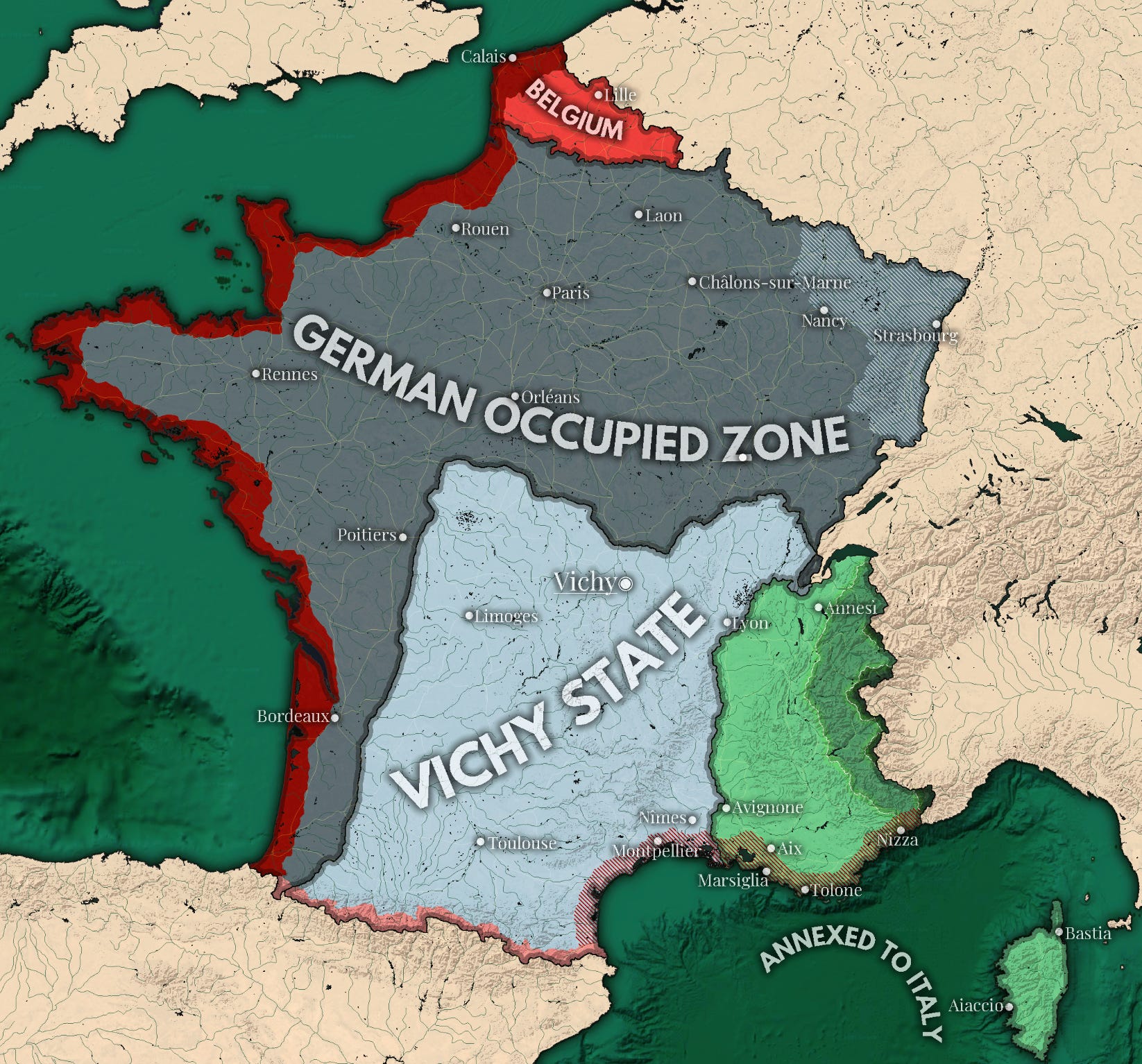
By the summer of 1940, however, Vichy stopped being known solely as one of the great spa capitols of the world when it became the de facto center of the “Free Zone”—the southern and central two fifths of France that were not directly occupied by the Axis powers. Although the new government called itself “The French State,” it was quickly known as “Vichy France,” thanks to the location of its new (if unofficial) capitol.
A collaborator state closely aligned with Germany, the Vichy government voluntarily sent more than 75,000 Jews to Nazi death camps, stripping the French Jews of their citizenship and property.
At least 72,500 of them were killed.
The French Revolution’s slogan of “Liberty, Equality, Brotherhood” was officially replaced by “Work, Family, Fatherland.”
Civil liberties were suspended, the media was censored, trade unions were abolished. Women were subjected to enforced subordination and encouraged to embrace traditional roles as wives and mothers. Divorce was nearly impossible and abortion was punishable by death.
“Degenerates” like communists, Romani, and anyone deemed undesirable were also rounded up and sent to concentration camps.
The Milice française, a paramilitary group created by the Vichy government, served to suppress the Resistance, persecute Jews and immigrants, apprehend them for deportation, and engage in starting street fights, which often resulted in summary executions.
At the head of the Vichy government was Maréchal Philippe Pétain, the oldest man ever elected Prime Minister of France at the age of eighty-four. Initially popular with the French as one of their great heroes of World War I, Pétain was given absolute, unchecked power by a demoralized and fragmented National Assembly. He soon turned his back on France’s allies to collaborate with the Nazi government. In his speeches, he frequently postured himself as a martyr—a gift to France who knew the truths of the world the rest of the country could not see.
He remained head of Vichy France until August, 1944, when he was removed against his will by the Nazi government in advance of the liberating Allied armies to Sigmaringen Castle in southern Germany.
After the war, Pétain was condemned to death for treason, but his sentence was commuted to life imprisonment due to his advanced age. He spent the last years of his life on a small island off the Atlantic coast of France, where his cognitive abilities steadily declined, resulting in frequent complaints that naked women were dancing about his room.
He died in 1951.
Joseph Darnand, head of the Milice française, was not so fortunate. He was executed by firing squad in 1945. Many others were convicted of treason and imprisoned**.
Vichyssoise never really caught on in France. This was partly due to the painful reminder of Pétains collaborationist government, but also because the French consider the dish an American invention. They much prefer their more traditional potage Parmentier.
I cannot say I blame them.
Vichyssoise remained popular in the United States until the early 1970s, when a sixty-one year-old banker died from eating a canned version of the soup that had been contaminated with botulism.
Vichyssoise
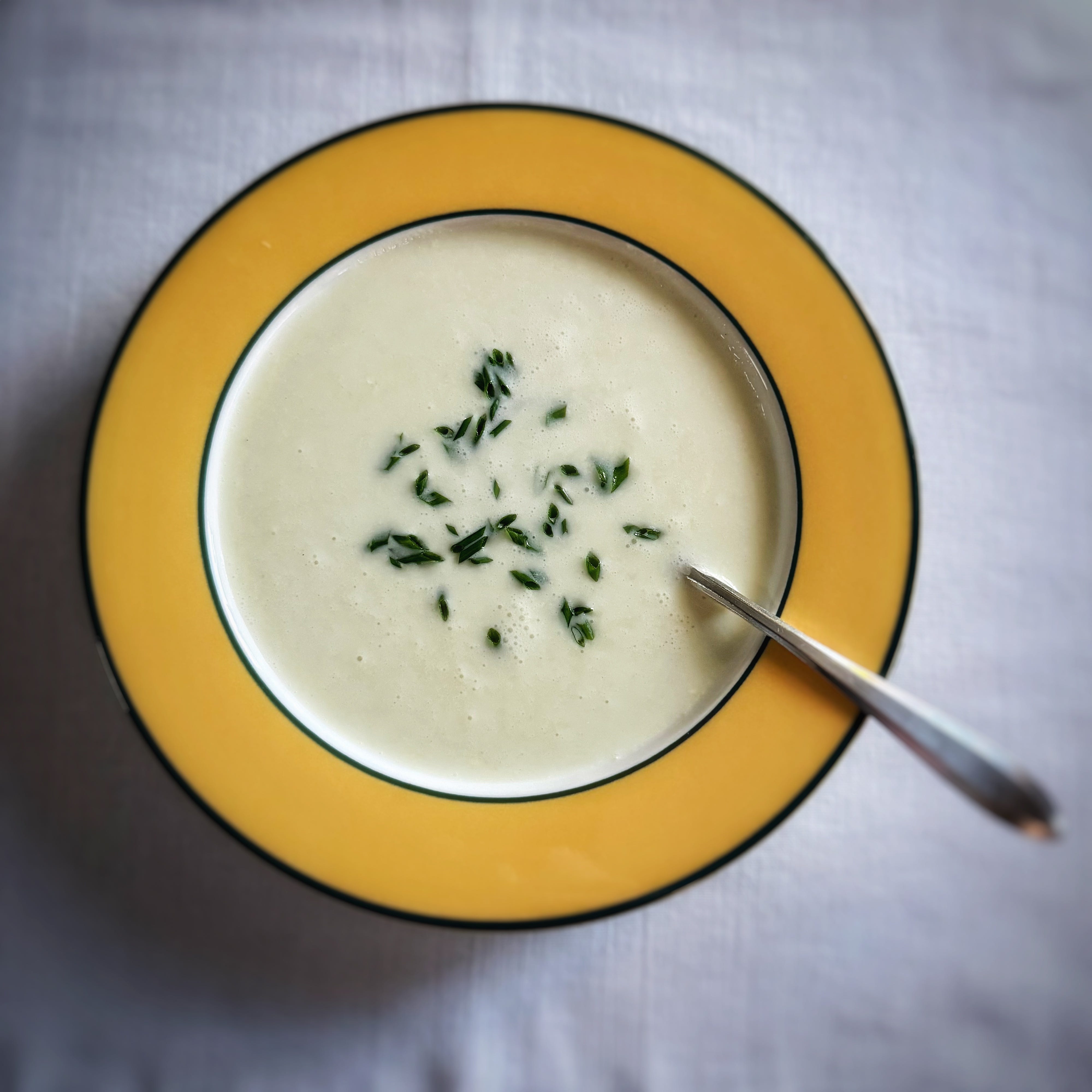
Have I got you gagging to get your hands on a bowl of this soup?
I didn’t think so.
Personally, I’m tired of vichyssoise. I’ve had my fill of it, but if you’d like to try it for yourself, all the information you need is right here. There are a lot of different thoughts on how to make this soup, so I’ve fallen back on my old, dependable copy of Larousse Gastronomique for the basics.
Writing has been a challenge this week what with the world on fire. I wrote this primarily to reminded myself that particular this flavor of horror has happened before and those who serve it typically don’t remain in business for long, and are called to account for their sins.
In the meantime, I’ll be over here perfecting my recipe for Nuremburgers, for when that glorious moment arrives.
Serves: 6 coldhearted collabos
Ingredients:
• 250 g of sliced leeks (whites only, like the true citizens of the Fatherland)
• 250 g of potato (russet or Yukon Gold) cut into large chunks
• 50 g of butter
• 1.75 liters of water (vegetable or chicken stock may also be used)
• 1 bayleaf and 1 generous sprig of fresh thyme, tied together with twine
• 2 dl (¾ cup) of fresh cream
• Plenty of salt and white pepper
Preparation:
Thinly slice the leeks. Wash them thoroughly to remove any undesirable grit. Shake off the excess water, but not too savagely.
Melt the butter in a heavy bottomed (and lidded) pot and melt over a medium-to-low heat. Add the sliced leeks, cooking them gently until translucent but not brown. This may take about 3 or 4 minutes.
Add your potatoes, and give everything a little stir.
Pour in the water (or preferred stock), then add the herbs. Bring the pot to a boil, then lower the heat to a simmer, cover, and let cook for 30-40 minutes.
Remove the lid and use an immersion blender directly in the pot and purée until smooth. If you are using a countertop blender, let the soup cool a little before blending and for G-d’s sake, do not fill it to the top unless you enjoy painful scalding. HOLD THE BLENDER LID CLOSED AND COVER WITH A TEA TOWEL OR SOMETHING SIMILAR.
Add the cream, stir, briefly return soup to a boil, then remove pot from the heat.
At this point, you may either strain your soup à la Chef Diat, or not.
Pour the soup into a container large enough to accommodate its volume, cover with cling film, and refrigerate until well chilled.
Add plenty of salt and white pepper to taste. Chilled items typically need much more seasoning that hot or room temperature ones, which is why I prefer to add them at the end.
To serve, ladle the soup into shallow bowls or deeper consommé cups. Serve it in the skulls of your enemies, for all I care.
Garnish with chopped, fresh chives and pray that nothing so evil tarnishes the reputation of your town.
Fuck ICE.
*This Charles Schwab is different from and not related to the Charles Schwab who founded the successful investment firm, which is probably a good thing, since the chilled soup-loving Schwab died deeply in debt.
**Many, unfortunately, were later exonerated.
There are two women of La Résistance whose work I find fascinating: Christiane Desroches-Noblecourt (biography: Empress of the Nile) and Marie-Madeleine Fourcade (biography: Madame Fourcade’s Secret War). I suspect both women supped on potage Parmentier.
The release of your recipe for Nuremburgers can’t come soon enough.
My father, a US diplomat and WWII veteran would serve chilled Avgolimono with avocado garnish at dinners where a chilled soup would be de rigueur rather than Vichyssoise.